EN
EN



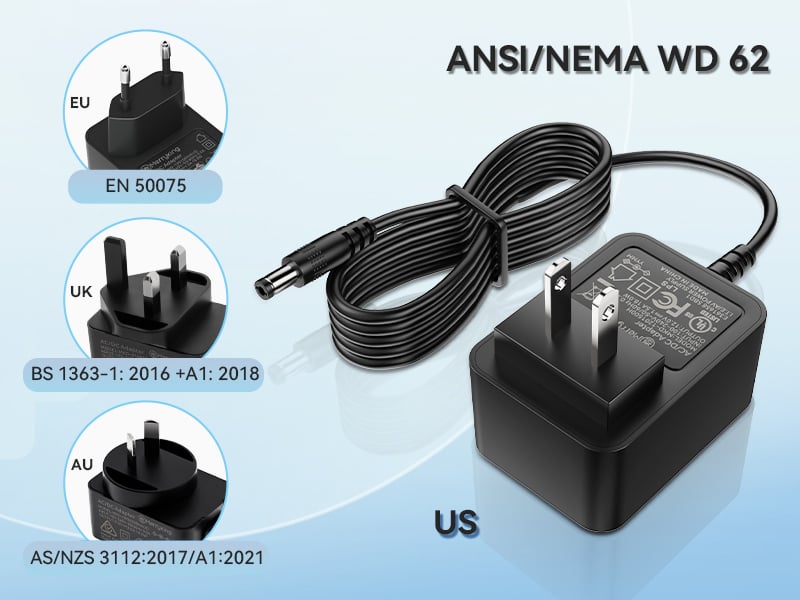
A switching adapter rated for 100-240V 50/60Hz input is designed for universal AC input, but the physical plug that connects to the wall outlet must match the specific standard of each country or region. Switching adapter plug types are defined by national and international standards that specify the plug shape, pin configuration, pin dimensions, voltage rating, and current carrying capacity. The International Electrotechnical Commission (IEC) publishes a classification system that categorizes plug types using letter designations, but each country may also reference its own national standard. When a manufacturer designs an adapter for global distribution, the plug type selection is driven by the target markets: an adapter sold in Germany must use the EU Schuko plug, one sold in the United Kingdom must use the BS 1363 fused plug, and one sold in the United States must use the NEMA 1-15 or NEMA 5-15 plug. Selecting the wrong plug type prevents the adapter from being physically inserted into the wall outlet, effectively blocking market access regardless of electrical compatibility.
The most common switching adapter plug types cover the major consumer markets worldwide. The EU plug (CEE 7/16, commonly called Europlug) features two round pins 4mm in diameter spaced 19mm apart and is accepted in virtually all European countries including Germany, France, Spain, Italy, and the Netherlands. The US plug (NEMA 1-15) has two flat parallel blades and is used in the United States, Canada, Mexico, and parts of Central and South America. The UK plug (BS 1363) features three rectangular pins in a triangular arrangement and includes a built-in fuse, mandatory in the United Kingdom, Ireland, and many Commonwealth countries. The AU plug (AS/NZS 3112) has two flat angled pins (in an inverted V shape) and optionally a third earth pin, used in Australia, New Zealand, and parts of the Pacific Islands. Additional plug types include the CN plug (GB 2099) for China, the JP plug (JIS 8303) for Japan, the KR plug (KSC 8305) for Korea, the IN plug (IS 1293) for India, and the AR plug (IRAM) for Argentina. Each plug type carries its own certification requirement, meaning that an adapter sold in Japan must carry PSE certification on the JP plug configuration, while the same adapter sold in Korea needs KC certification on the KR plug.
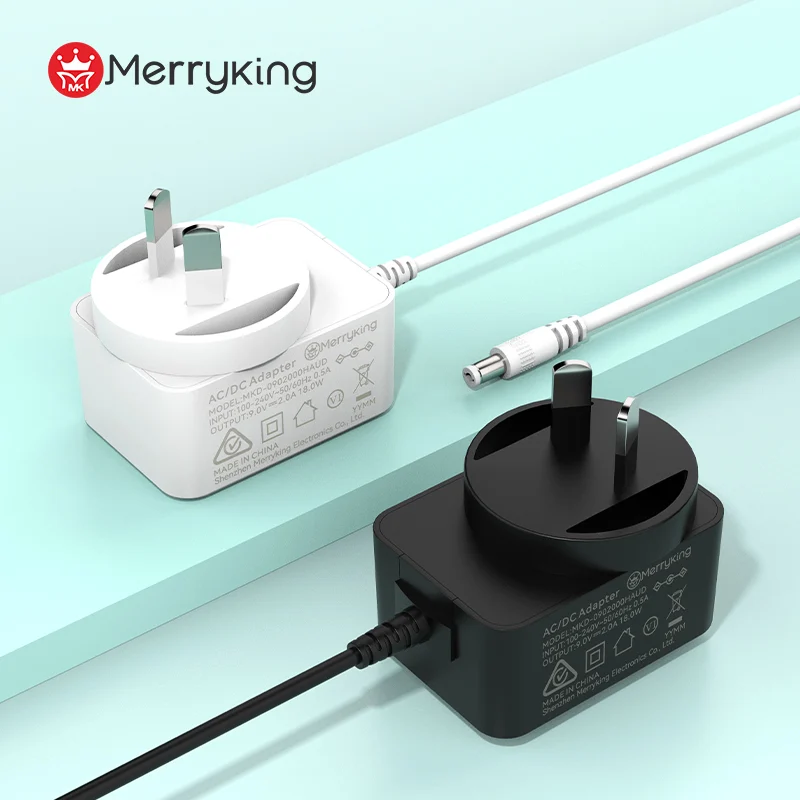
One of the most practical solutions for switching adapter plug types is the interchangeable plug system, which allows a single adapter body to accept multiple snap-on plug heads. This approach, used in adapters ranging from 12W to 65W, includes plug attachments for EU, US, UK, AU, CN, AR, KR, JP, and IN configurations. The interchangeable system offers several advantages: a single product SKU can serve all target markets, reducing inventory complexity and warehouse management costs. The user or installer simply snaps on the appropriate plug for the destination country, and the adapter is ready for use. From a certification perspective, each plug type must be individually tested and certified, but the adapter body itself is certified once. This means the manufacturer's certification portfolio must cover each plug type separately, which is why manufacturers holding sixteen international certifications can offer interchangeable systems with full compliance across all configurations. The snap-on mechanism is designed for mechanical durability, typically rated for over 1,000 insertion and removal cycles without degradation of the electrical contact.
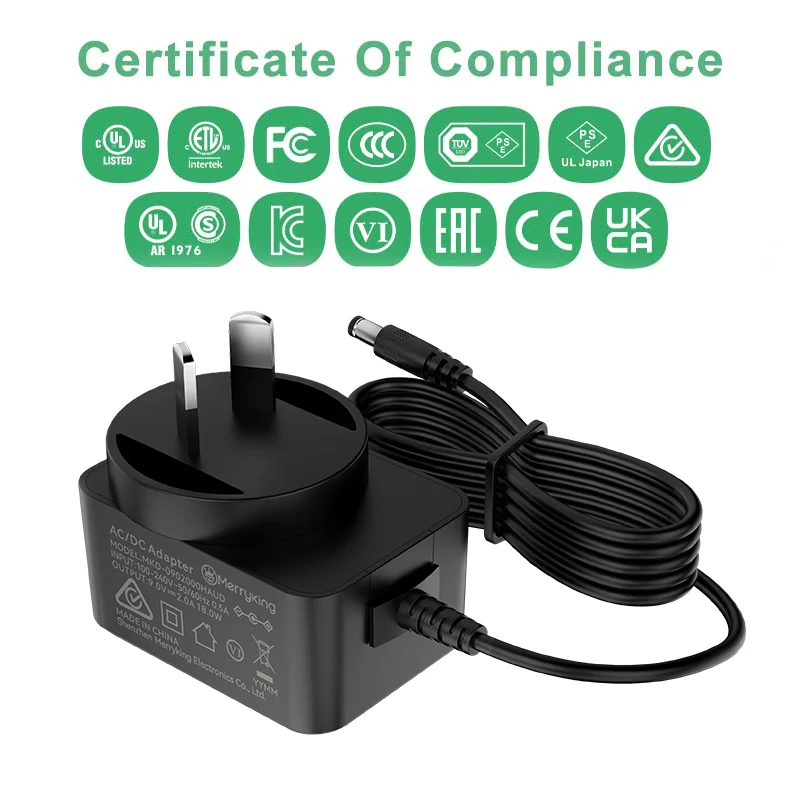
Switching adapter plug types are not just physical connectors; each plug configuration triggers specific certification requirements in its respective market. The EU plug requires CE-LVD and CE-EMC certification under the Low Voltage Directive and EMC Directive. The US plug requires UL or ETL certification based on UL 62368, plus FCC certification for electromagnetic compliance. The UK plug requires UKCA certification under BS EN 62368-1:2014+A11:2017, and the BS 1363 standard mandates an internal fuse in the plug. The AU plug requires SAA and RCM certification. The JP plug requires PSE certification. The KR plug requires KC and KCC certification. The IN plug requires BIS certification. The AR plug requires S-MARK certification. When an adapter uses an interchangeable plug system, each plug head must carry the corresponding certification mark, and the adapter body's certification must reference all compatible plug types. This layered certification requirement means that sourcing an adapter with the correct plug type is not solely a mechanical compatibility question but also a regulatory compliance question.
A consumer electronics company launching a smart speaker in nine countries simultaneously faced the challenge of managing switching adapter plug types across all markets. The initial plan involved sourcing nine separate adapter SKUs, each with a fixed plug type for one country. This approach required nine separate certification packages, nine production runs with minimum order quantities per SKU, and complex inventory management to ensure each warehouse stocked the correct adapter for its region. After evaluating interchangeable plug systems, the company selected a 12V 2A adapter with snap-on plug heads for EU, US, UK, AU, CN, AR, KR, JP, and IN. The adapter body carried all sixteen international certifications, and each plug head was individually certified for its target market. The consolidated approach reduced the SKU count from nine to one adapter body plus nine plug attachments, cut certification management overhead by 60 percent, and simplified the supply chain because the adapter body could be shipped globally with plug attachments distributed regionally. The product launch proceeded on schedule across all nine markets with a single adapter platform.
When evaluating switching adapter plug types for a product, buyers should consider the following factors: identify all target markets and list the required plug types for each, verify that the adapter manufacturer holds valid certifications for each plug type, confirm that the plug dimensions meet the national standard (not all plugs labeled EU are identical; CEE 7/16 and CEE 7/17 have different pin diameters), and decide between fixed-plug and interchangeable-plug approaches based on the number of target markets and inventory management preferences. For products targeting a single region, a fixed-plug adapter is typically more cost-effective. For multi-region products, an interchangeable system reduces total cost of ownership through simplified inventory and certification management. Buyers should also consider that some countries have multiple compatible plug types; for example, China accepts both CN (GB 2099) and EU-style plugs in some outlets, but the CN plug is the certified standard for safety compliance.
Can I use a travel plug adapter with my switching power supply instead of buying a region-specific adapter?
Travel plug adapters change the physical plug shape but do not convert voltage or modify the adapter's electrical characteristics. Since switching adapters rated for 100-240V 50/60Hz already accept universal input, a travel plug adapter is electrically safe for short-term use. However, travel plug adapters are not certified for permanent installation and may not meet the national safety standards required for product certification. For commercial products, the adapter must carry the correct plug type and certification for each target market.
What is the difference between EU CEE 7/16 and CEE 7/17 plugs?
The CEE 7/16 (Europlug) has two round pins 4mm in diameter and is rated for up to 2.5A at 250V. It fits outlets in most European countries. The CEE 7/17 has thicker pins (4.8mm diameter) and is rated for higher currents up to 10A, but it does not fit all European outlets, particularly recessed Schuko outlets in Germany. For most switching adapter applications up to 65W, the CEE 7/16 Europlug is the standard choice.
How do interchangeable plug systems handle the UK fuse requirement?
The UK BS 1363 standard requires a fuse inside the plug. In interchangeable plug systems, the UK plug head contains the required fuse (typically 3A or 5A depending on the adapter's rated current). The fuse is integrated into the snap-on UK plug attachment, not the adapter body. This design ensures compliance with BS 1363 while maintaining the universality of the adapter body across all plug types.