EN
EN




Before contacting any manufacturer, verify the voltage your device actually requires. Read the device label, check the input range of the internal regulator, and measure the voltage under full load if possible. Some devices accept a range, such as 19V to 20V, while others need a tightly regulated single value. You should also determine the current draw at start-up and steady state, because the adapter must hold the voltage within specification while delivering the peak current. If your device has a sensitive load such as a motor, communication module, or sensor array, tell the manufacturer the ripple and regulation requirements. A custom voltage with tight regulation is a different engineering task than a custom voltage with a wide tolerance.
The output voltage of an AC adapter is determined by the transformer turns ratio, the feedback control loop, and the rated output of the secondary circuit. Moving from 24V to 48V, for example, changes the winding design, the voltage rating of the output capacitors, and sometimes the controller configuration. A reputable Fabricator adapteris AC will evaluate whether your voltage can be produced by reconfiguring an existing platform or whether a new transformer and PCB layout are required. Reconfiguring an existing platform is faster and cheaper, because the control scheme, protection circuits, and thermal design are already proven. A fully new design adds development time, tooling, and testing cost, so ask your manufacturer to confirm which path applies to your requested voltage before you commit to a schedule.
Certification is the area where custom voltages create the most surprises. Safety certificates are issued for specific models with specific output ratings. A certificate for a 24V model does not automatically cover a 48V version of the same housing, so the manufacturer must either extend the certificate or run new testing. Before you finalize the specification, confirm which safety marks you need for your destination market, such as UL or cUL for North America, f or the EU, confirm CE conformity requirements; for Great Britain, confirm whether CE, UKCA, or both are accepted under current rules, PSE for Japan, or BIS for India. Ask whether the manufacturer can reuse partial test data from a certified platform and how long the additional certification will take. Some factories hold broad certification coverage across their standard range, which shortens the process when your custom voltage is close to an already-certified output.
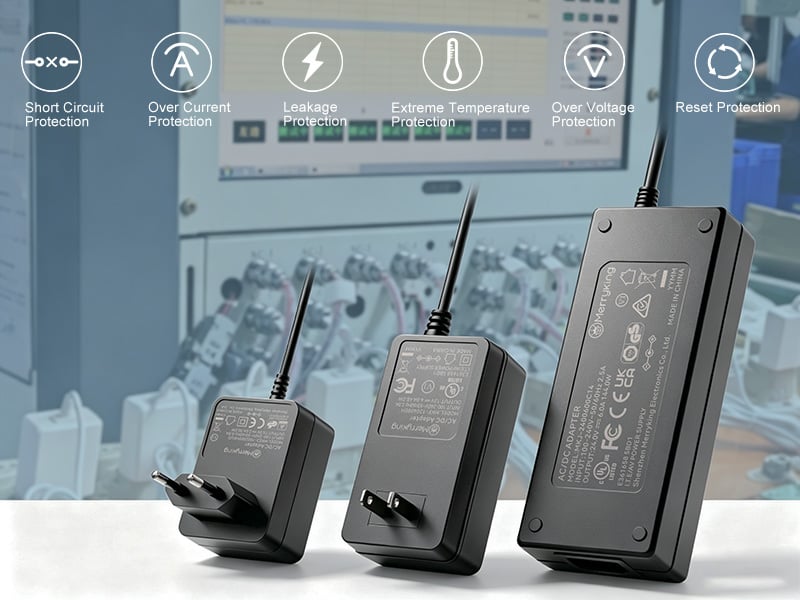
Un voltaj personalizat este util doar dacă produsul livrat menține efectiv acel voltaj sub sarcină, deci specificația trebuie să definească toleranța acceptabilă și modul de măsurare. Indicați toleranța tensiunii de ieșire, de exemplu ±5%, și limita de ondulație la sarcină maximă, iar apoi cereți producătorului să confirme condițiile de testare, cum ar fi tensiunea de intrare, nivelul de sarcină și temperatura ambiantă la care sunt verificate valorile. Dacă dispozitivul dumneavoastră are un curent de vârf la pornire, specificați că adaptorul trebuie să-l susțină pe durata necesară fără a declanșa protecția. Stabiliți împreună modul în care sunt testate mostrele ingineresti și cine analizează datele de testare înainte de producție. Aceste acorduri pot părea detalii administrative, dar ele transformă o cerere de voltaj personalizat într-un contract măsurabil și verificabil între dumneavoastră și producător.
A company constructing a series of network switches required a 48V desktop adapter equipped with a locking output connector. The standard catalog included only 12V and 24V models; thus, a custom output voltage was necessary. The manufacturer assessed the request and determined that the existing 36W–65W desktop platform could be adapted to deliver 48V by substituting the transformer and selecting an output capacitor with an appropriate voltage rating. Since the platform’s core architecture remained unchanged, its protection circuits and thermal design were retained, enabling the manufacturer to extend the existing safety certification via focused testing—rather than initiating a full new certification process. Engineering samples were delivered within the scheduled timeline; the customer verified the 48V output under full load using a 48V multimeter and a load bank; and the project advanced into production, supported by documented test reports. The central insight from this case is that delivering a custom output voltage is standard practice for an experienced manufacturer—provided the electrical specifications are unambiguous and the certification strategy is jointly agreed upon early in the development cycle.
Postquam fabricator exemplaria technica adfert, ea validare oportet contra tuum verum instrumentum, non solum contra conformationem in mensa. Mensurare tensionem exirentem ad nullum onus, ad onus plenum, et durante initio; et examinare undulationem per oscilloscopium, si tuum instrumentum est sensibile. Facere examen temperaturae intra tui clausurae spatium, quia fluxus aeris circa adaptatorem ad hoc speciale afficit reductionem potestatis. Confirmare notae exemplarium congruere cum requisitis mercati tui, et postulare relationes experimentorum quae certificatum sustinent. Antequam productio massiva incipiat, convenire cum fabricatore de plano qualitatis: experimentum aetatis in omni unitate (100 %), inspectio per exempla secundum AQL ante expeditionem, et conditiones garantiae. Garantia trium annorum communis est in industria adaptatorum, et processus reclamandi debet scribi in conventione emptionis, ut utraque pars sciat quomodo tractentur unitates defectuosae.
Potestne Fabricator adapteris AC producere quamlibet tensionem exirentem quam peto?
Intra limites platformae, plerique fabricantes possunt producere late spectrum voltatuum ex output per adaptationem transformatoris et rete feedback. Voltatus extremi alti aut bassi, aut voltatus qui necessitant transformatorum novum totum et PCB, tempus longius consumunt et plus pecuniae exigunt, sed tamen possibiles sunt in fabbrica quae habet facultatem technicam.
Num voltatus ad usum specialem requirit certificationem novam?
Plurimum sic, nisi fabricator tenet certificatum quod iam includit exactam valorem voltatus ex output et modello. Corpora certificantia examinant modulos specificos, itaque etiam parva mutatio in voltatu ex output potest exigere examen extensionis. Confirmare planum certificationis ante productionem.
Quomodo vitare possum defectus dispositivorum relativos ad voltatum cum adaptatoribus ad usum specialem?
Praecise specificare tolerantiam voltatus, ondulationem, et requisita currentis; probare exemplaria contra onus verum; et eligere fabricatorem qui documentat relationes examinis pro omni catena. Specificatio stricta et planum qualitatis documentatum praecavent plerosque defectus in campo.